
Play San Quentin 2 Now!
Home → Strategy
San Quentin 2 Strategy
Approaching San Quentin 2 sensibly
Nolimit City released San Quentin 2 in 2024 as a sequel to their earlier hit, establishing a specific baseline for player expectations regarding mechanics and payout structures. The theoretical return to player stands at 96.13%, which implies a house edge of exactly 3.87% over extended play sessions. This mathematical framework dictates that players must accept variance rather than expecting consistent short-term wins from the start.
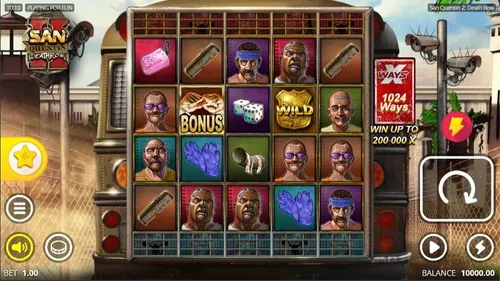
The game utilizes a 5x4 reel layout that expands up to 6 rows high through Locked Enhancer Cells revealing symbols like Wilds or Razor Split icons. These expanding grids increase the complexity of the base game, directly influencing how often winning combinations form during standard spins. Understanding this grid expansion is crucial before engaging with the bonus features or adjusting stake levels accordingly.
Players can choose between multiple RTP configurations, with options including 94.03%, 92.11%, and 87.13% alongside the default 96.13%. Selecting a lower configuration significantly increases the house advantage, altering the long-term profitability of every spin placed on the machine. Comparing this flexibility to Mental 2 reveals different volatility profiles despite both titles originating from Nolimit City studios.
Bankroll rules that hold up
A defined bankroll represents the total capital allocated for playing San Quentin 2, separate from personal finances or essential living expenses. With a maximum win potential of 200,000x the stake, the variance requires substantial reserves to withstand inevitable dry spells without ruin. Setting aside funds equal to five hundred minimum bets provides a buffer against the extreme volatility inherent in this specific title.
Flat betting maintains the same stake every round, preventing rapid depletion of the bankroll during losing streaks common in high-variance slots. Starting with the minimum bet of $0.20 allows for 500 spins per unit of currency, extending playtime significantly compared to higher stakes. Progressive staking strategies raise stakes after losses but only shorten the time to ruin by increasing exposure to the 3.87% house edge.
The welcome bonus of 300% up to €2,000 plus 100 free spins offers additional playing power if utilized under strict wagering conditions. Each bonus euro must be turned over multiple times before withdrawal eligibility is granted, effectively reducing the real value of the promotional funds. Players should calculate the required turnover carefully to ensure the bonus terms do not negate the benefits of the extra credits provided.
Bet sizing against volatility
San Quentin 2 features extremely high volatility, meaning wins are infrequent but potentially massive when they occur within the 1,024 ways to win structure. Betting near the maximum limit of $100 per spin exposes the bankroll to rapid fluctuations due to the insane variance rating assigned by analysts. Smaller bets between $0.20 and $1 allow for more spins to trigger the Green Mile Free Spins bonus feature reliably.
The Green Mile Free Spins bonus serves as the main attraction, where Locked Enhancer Cells reveal top-paying symbols to expand the grid further. Triggering this feature requires landing specific scatter symbols, which becomes statistically harder when betting small amounts due to fixed probability thresholds. Balancing bet size with bonus frequency ensures that players remain engaged during the long periods between significant payouts.
Comparing San Quentin 2 to Mental 2 highlights differences in max win caps, with the latter offering 99,999x versus San Quentin 2's 200,000x potential. Higher max wins correlate with longer droughts between payouts, necessitating a larger bankroll relative to the chosen stake level. Players must adjust their bet sizing strategy based on whether they prioritize frequent small wins or rare large jackpots.
RTP configurations allow operators to offer 96.13%, 94.03%, 92.11%, or 87.13% returns, directly impacting the expected loss rate per hour played. Choosing a site with the highest RTP configuration minimizes the theoretical drain on the bankroll over thousands of spins. This choice remains constant regardless of bet size, making it a critical factor in long-term sustainability for serious players.
Session limits worth setting
Setting a time limit prevents fatigue-induced errors while playing San Quentin 2, especially given its intense visual effects and fast-paced Locked Enhancer animations. A one-hour session at $1 per spin results in 3,600 spins, costing approximately $3,600 before accounting for any returned winnings. This expenditure aligns closely with the 3.87% house edge, ensuring losses remain predictable and manageable within predefined budgets.
Loss limits protect the bankroll by stopping play once a predetermined amount is exhausted, avoiding the temptation to chase losses with higher stakes. Losing $100 on San Quentin 2 with a $1 bet means enduring roughly 100 consecutive losing rounds or fewer wins than average. Accepting these limits as hard boundaries helps maintain discipline and prevents emotional decision-making during volatile gameplay stretches.
Win goals provide a clear exit strategy, such as stopping after doubling the initial bankroll or hitting a specific multiplier threshold. Achieving a 100x win on a $0.20 bet yields $20, requiring only 100 units of profit to meet modest targets. Comparing this approach to Mental 2 shows that smaller max wins may require less patience to reach comparable percentage gains.
Frequency checks ensure players review their balance periodically, allowing them to assess performance against the theoretical 96.13% RTP over time. Monitoring outcomes every fifty spins helps identify deviations from expected results without interrupting the flow of the game excessively. Consistent tracking supports informed decisions about continuing play or cashing out remaining funds responsibly.
Why chasing losses fails
Chasing losses involves increasing bet sizes after deficits to recover lost funds quickly, which accelerates bankruptcy in high-volatility games like San Quentin 2. Raising stakes from $0.20 to $10 after a losing streak multiplies the impact of the 3.87% house edge on each subsequent spin. This strategy ignores the independence of each spin, falsely assuming past results influence future outcomes in a random number generator environment.
The 200,000x max win cap represents an astronomical payout that occurs rarely, making it unrealistic to target for immediate loss recovery. Attempting to reach this milestone through aggressive betting ignores the statistical improbability of triggering the Green Mile Free Spins feature frequently enough. Players who persist in this manner often deplete their entire bankroll before experiencing any significant positive variance events.
Mental 2 offers a lower max win of 99,999x, yet still requires extreme patience and disciplined bankroll management to achieve such results. Chasing losses in either title disregards the fundamental principle that the house always retains an edge over the long term. Accepting losses as part of the entertainment cost preserves financial stability and allows for continued participation in future sessions.
San Quentin 2: key facts
| Parameter | Value |
|---|---|
| Game | San Quentin 2 |
| Studio | Nolimit City |
| Released | 2024 |
| RTP | 96.13% |
| House edge | 3.87% |
| Volatility | Extremely high / Insane |
| Max win | 200000x |
| Reels | 5x4 base |
| Paylines / ways | 1,024 ways to win |
| Bet range | $0.20 – $100 |
Common systems and their limits
San Quentin 2 operates on a fixed theoretical return of 96.13%, which establishes a permanent house edge of 3.87% against the player. This mathematical reality means no betting progression can overcome the built-in statistical disadvantage over any significant volume of spins. Players attempting to reverse-engineer this edge will invariably face the same long-term negative expectation regardless of their strategy.
The game features an extremely high volatility profile, meaning wins are rare but potentially massive, reaching up to 200000x the stake. Such extreme variance creates long periods of bankroll depletion that standard progressive systems cannot sustain without risking total ruin. Unlike low-volatility titles, this structure demands a much larger financial buffer to survive the dry spells between major payouts.
Alles Spitze by Merkur offers a different risk model with a 90.85% RTP and a capped max win of 500x, providing more frequent but smaller returns. San Quentin 2’s 1,024 ways to win and xWays mechanics create a distinct mathematical landscape that does not align with conservative flat-betting strategies. The difference in payout structures dictates entirely different approaches to managing session funds and expectations.
Flat betting explained
Flat betting involves maintaining a constant stake amount for every single spin, such as $0.20 or $100, without adjusting for previous outcomes. This method ensures that the player exposes a predictable portion of their bankroll per hour, minimizing the risk of rapid capital loss during losing streaks. The consistency allows for better tracking of actual performance against the expected 96.13% return rate over time.
With a maximum win potential of 200000x, flat betting prevents players from chasing losses with escalating stakes that could deplete funds before a big hit occurs. Since the game is a slot with no cash-out button, the outcome of each spin remains independent of the bet size chosen. This independence makes stake consistency a rational approach to preserving the bankroll for extended play sessions.
The bet range spans from $0.20 to $100, allowing players to select a unit size that aligns with their total available funds. By keeping bets level, the player avoids the psychological trap of increasing wagers after losses, which statistically accelerates the path to ruin. This disciplined approach respects the game's insane volatility while ensuring the bankroll lasts through the natural variance of the 5x4 reel layout.
Progressive staking risks
Progressive staking involves raising the wager after a loss, a strategy that fundamentally alters the distribution of risk without changing the house edge. In San Quentin 2, escalating bets during a downturn requires exponential bankroll growth to sustain the sequence, quickly exceeding the maximum bet limit of $100. This mismatch between required capital and table limits makes the strategy mathematically unviable for most players.
The game’s 96.13% RTP remains constant regardless of bet size, meaning higher stakes do not improve the probability of winning or hitting the 200000x max win. Instead, progressive systems only shorten the duration of play by draining the bankroll faster during inevitable losing runs. The locked enhancer cells and expanding grid features do not compensate for the increased variance introduced by fluctuating stakes.
Unlike Alles Spitze, which caps wins at 500x and may tolerate smaller fluctuations, San Quentin 2’s high volatility punishes erratic betting patterns severely. Attempting to recover losses through raised stakes often leads to hitting the table limit just before a potential bonus trigger. This limitation forces the player to accept the lower RTP configurations if they wish to continue playing under different conditions.
What the maths actually allows
San Quentin 2 offers multiple selectable RTP configurations, with 96.13% being the default and highest setting available to players. Other versions circulate with returns of 94.03%, 92.11%, and 87.13%, significantly altering the expected value of every spin placed. Players must verify which configuration is active, as the lower percentages drastically increase the house edge and reduce long-term returns.
The theoretical return of 96.13% implies a house edge of 3.87%, meaning the casino retains this percentage of all wagers over millions of spins. For a player betting $100 per spin, this translates to an expected loss of $3.87 per rotation, accumulating rapidly over time. Understanding this fixed cost is essential for determining whether the potential for a 200000x win justifies the statistical disadvantage.
The game releases from Nolimit City in 2024 utilizes a 5x4 base grid that expands via Locked Enhancer Cells, adding complexity to the paytable. While the visual mechanics suggest dynamic odds, the underlying mathematics remain governed by the selected RTP and the 1,024 ways to win. Players should recognize that these features enhance entertainment value rather than improving the fundamental profitability of the game.
Reading variance honestly
San Quentin 2 is classified as having extremely high or insane volatility, indicating that wins will be infrequent but substantial when they occur. This characteristic requires players to maintain a bankroll capable of withstanding hundreds of consecutive losses without triggering emotional decision-making. The 200000x max win cap is a rare event, not a realistic expectation for any single session or day of play.
The Green Mile Free Spins bonus serves as the primary vehicle for large payouts, yet its activation frequency is dictated by the game's random number generator. With an RTP of 96.13%, the overall return is averaged across both base game losses and bonus round gains. Players must accept that the majority of spins will result in zero or minimal returns, contributing to the high variance profile.
Comparing this to Alles Spitze, which has high volatility but a modest 500x max win, highlights the extreme risk-reward ratio of San Quentin 2. The latter offers life-changing potential but demands a much higher tolerance for financial drawdowns during gameplay. Honest assessment of one's bankroll and risk appetite is crucial before engaging with such a volatile product from Nolimit City.
Learning the game in demo first
San Quentin 2 is an online slot developed by Nolimit City and released in 2024, offering a theoretical RTP of 96.13% with a house edge of 3.87%. This percentage represents the long-term average return over hundreds of thousands of spins rather than a guarantee for any single session or short play period. Players should understand that the extreme volatility means wins are infrequent but potentially large, requiring patience during dry spells. A comparison with Book of Dead shows a similar high-risk profile, though its max win is significantly lower at 5000x compared to San Quentin 2's 200000x cap.
The base grid starts as a compact 5x4 layout with 1,024 ways to win, but Locked Enhancer Cells above and below each reel can expand the structure up to 6 rows high. These cells reveal top-paying symbols, Wilds, Razor Split mechanics, or xWays symbols, fundamentally changing the probability landscape of each spin. Understanding this dynamic expansion is crucial before risking real money, as it dictates the frequency and size of potential payouts. The Green Mile Free Spins bonus serves as the primary feature where these expanded grids yield their most significant rewards.
Testing the game in demo mode allows players to observe how the 4-4-4-4-4 starting configuration interacts with the enhancer cells without financial loss. This practice helps familiarize users with the insane volatility characteristics typical of Nolimit City titles, preparing them for long periods of no returns. The demo version mirrors the real-money mechanics exactly, ensuring that the strategic approach remains valid when transitioning to live play. Recognizing the pattern of symbol reveals prevents misinterpretation of random variance as a broken system.
Adjusting stakes to your budget
The bet range for San Quentin 2 spans from $0.20 to $100 per spin, allowing flexible bankroll management for different player segments. A minimum stake of $0.20 enables extended play sessions, which is essential given the extremely high volatility and low hit frequency inherent in the design. Conversely, the maximum bet of $100 caters to high rollers seeking rapid exposure to the 200000x max win potential, though it depletes funds quickly. Flat betting at the lower end preserves the bankroll longer than progressive staking strategies, which only accelerate time to ruin.
Calculating the cost of a standard hour of play requires multiplying the stake by the average spins per minute, typically around 60 to 80 for slots like this. At $0.20 per spin, hourly costs remain manageable, whereas $100 per spin demands a substantial bankroll to withstand the inevitable losing streaks. The 96.13% RTP indicates that for every $100 wagered, approximately $96.13 is returned theoretically, leaving a 3.87% house edge. This mathematical reality persists regardless of bet size, meaning higher stakes do not improve the odds of winning, only the scale of potential losses or gains.
Comparing the volatility profile to Book of Dead highlights why stake adjustment is critical; while both are high-variance games, San Quentin 2's 200000x cap justifies more conservative betting. The 94.03%, 92.11%, and 87.13% RTP configurations available in some jurisdictions further emphasize the need to check the specific game version. Players must verify which RTP tier is active, as lower configurations increase the house edge to 7.89% or higher. Selecting the highest 96.13% version minimizes the statistical disadvantage inherent in the gameplay loop.
Recognising a bad session
A bad session often begins when the bankroll drops below 20% of its initial value due to the extremely high volatility of San Quentin 2. With a house edge of 3.87%, even small bets will eventually erode funds if the player does not encounter the Green Mile Free Spins bonus. Progressive staking systems that raise stakes after losses are particularly dangerous here, as they amplify the impact of the built-in mathematical disadvantage. The lack of a cash-out button in this slot means players cannot lock in profits mid-feature, increasing the risk of giving back winnings.
Monitoring the number of spins relative to the bankroll provides a clear indicator of session health, especially when facing the 1,024 ways to win mechanic. If a player has spun 500 times without triggering the main bonus on a $0.20 stake, the expected return is already negative due to variance. The theoretical RTP of 96.13% applies over millions of spins, so short-term deviations are normal but signal the need for caution. Comparing this experience to Book of Dead’s more predictable 5000x max win helps contextualize the frustration of prolonged dry spells.
Identifying emotional distress or the urge to chase losses is a critical step in recognizing a deteriorating session, independent of the numerical data. The insane volatility of Nolimit City games is designed to create intense swings, which can cloud judgment and lead to irrational betting decisions. Setting a strict loss limit before starting ensures that players stop when the math no longer favors continued engagement. The 200000x max win is a rare outlier event, not a realistic expectation for any individual session or even a year of play.
Stopping while ahead
Securing profits in San Quentin 2 requires defining a clear profit target before engaging with the 5x4 base grid and its expanding enhancer cells. Since the game lacks a cash-out button, players must manually withdraw winnings after hitting a significant feature payout, such as the Green Mile Free Spins. The 200000x max win is a statistical anomaly that occurs rarely, so smaller but consistent bonuses provide more reliable opportunities to lock in gains. Unlike crash games, there is no mechanism to exit mid-spin, making pre-defined stop-loss and take-profit levels essential.
The 96.13% RTP suggests that over time, the casino retains 3.87% of all wagered money, meaning sustained profitability is mathematically improbable for most players. Stopping while ahead acknowledges this edge and preserves the bankroll for future sessions or other activities. A successful session might involve hitting a moderate bonus round that doubles the initial deposit, providing a natural point to conclude play. Comparing this outcome to Book of Dead’s 5000x max win illustrates that while both games offer large payouts, the frequency differs significantly.
Implementing a disciplined routine involves reviewing the balance after each major feature trigger and deciding whether to continue based on predefined criteria. The extremely high volatility means that a large win can be quickly reversed if the player continues spinning without restraint. Keeping records of sessions helps identify patterns in behavior and reinforces the habit of stopping when the target is met. The 3.87% house edge ensures that the longer the session lasts, the closer the results will align with the theoretical return.
Responsible play in practice
Setting a fixed bankroll for each session is the first step in responsible gaming, particularly for a high-volatility slot like San Quentin 2. The bet range of $0.20 to $100 offers flexibility, but players should choose a stake that allows for at least 100 spins without depleting funds. This buffer accounts for the extreme variance inherent in the game, reducing the pressure to chase losses after a unlucky streak. Treating the bankroll as entertainment expenditure rather than an investment aligns expectations with the 3.87% house edge.
Time limits are equally important, as the immersive nature of Nolimit City’s features can lead to unintentional extended play sessions. Using timer alerts or external reminders helps maintain perspective and prevents fatigue-induced poor decision-making. The 96.13% RTP is a long-term statistic irrelevant to the immediate experience, so focusing on duration rather than return keeps the activity recreational. Comparing this approach to Book of Dead’s simpler mechanics highlights that complexity does not justify longer playtimes.
Accessing support resources and utilizing self-exclusion tools provided by casinos ensures that problematic behavior is addressed promptly. The insane volatility of San Quentin 2 can trigger addictive patterns, making external accountability measures vital for sustainable play. Regularly reviewing session history helps identify early signs of trouble, such as increasing bet sizes or extending playtime beyond planned limits. Responsible play involves accepting the 3.87% house edge as the cost of entertainment and never viewing the game as a source of income.
DemoRTP & VolatilitySymbols & PayoutsBonus FeaturesStrategyBonusesMobileDownload & AppMax WinSimilar GamesReviewFAQSitemap
San Quentin 2 2026